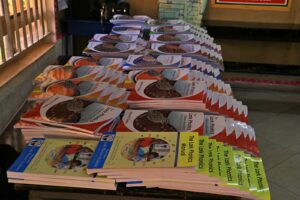
Developing the reading skill among children during their nursery and primary years is core in unlocking their potential in education and life in general. Children who miss out on learning to read in their first six years in school over struggle with interpretation of concepts in upper school. Some even drop out because they fail to learn since most of the learning comes in print that requires interpretation through reading.
Previously, traditional methods of teaching the reading skill, which often emphasize rote memorization and repetition, were employed in schools. The syllabic method, whole word, whole sentence and alphabet methods are some of the traditional methods that dominated the teaching of the reading skill in the previous century. As an adult, I am sure you remember how you used to sing syllables and join them to form words without knowing the sounds in them. Sometimes, you would spell words and then read them. There was and there is no connection between the letters you would say during spelling and what they would say during word pronunciation / reading. Nevertheless, you learnt how to read but the hard way.
A lot has changed. Much as traditional approaches are still needed, recent educational research suggests the use of phonics-based instructions in the teaching of the reading skill. The phonics – based instruction focuses on the relationship between sounds and their corresponding letters. In other words, phonics is the teaching of reading, writing and spelling using sounds but not letter names (the alphabet).
As a nation, the early 2000s ushered our education system into the phonics revolution. Urban schools were the first to informally adopt the approach due to its outstanding advantages. Two decades down the road, the phonics revolution has taken over both private and government schools even in the rural areas. It’s a bush fire that none can neither stop nor explain how it has spread.
The government too through support from USAID introduced the Early Grade Reading (EGR) program that focuses on teaching reading through phonics – based instruction but with a local language context.
But why phonics out of all reading approaches?
Let’s start from here. English is a complicated language. It has 26 letters of the alphabet but they make 44 sounds or phonemes. The 44 sounds come in over 220 spellings or graphemes. One sound can be written in several alternative ways. Similarly, one spelling can make lots of different sounds. So, to avoid confusion, reading must be taught following a careful and systematic approach. And that’s what phonics – based instruction does.
Children start by learning the 42 major sounds of English. Borrowing from the jolly phonics program, each of these 42 sounds is introduced with a storyline, song and action. And that makes learning multi-sensory, easy, simplified and fun for the children especially when a repertoire of resources is involved.
Once children have mastered the 42 sounds, they are introduced to lots of other reading aspects. The approach opens their minds wider to the fact that the sounds they already learnt can be written in several other ways (alternative spellings). For example, they are taught that the sound /ee/ which they learnt in Baby class, can be spelt or written in over 10 other ways which are: “ee” as in tree, “ea” as in bean, “y” as in happy, “e-e” as in theme, “e” as in ego, “ei” as in receive, “ey” as in key, “ie” as in thief, “ae” as in algae, “eo” as in people, “oe” as in phoenix, “ay” as in quay and “i” as in ski. The phonics approach spreads these different spellings in different classes over the years. With this kind of exhaustive teaching, the phonics approach not only breeds children into good readers but also excellent spellers.
At the start, the learners are taught only sounds without bringing in the element of the alphabet or letters names. The letter names are then introduced after the children have fully mastered and practiced all the single sounds. If sounds and letters are taught simultaneously, confusion of sounds and letters often arises. As parent and teacher, you need to learn from the phonics approach never to buy or make the alphabet chart for your three year olds before they learn and fully master sounds.
The phonics approach is very systematic. Once understood, the teacher knows where to start and where to go thereafter. Learners are taught sounds which are the smallest units of words. The sounds are used to construct words through blending. Words are used to build phrases like (a cat on a mat). From the words and phrases, sentences are constructed. Finally, the teacher and the learner arrive at stories that are formed from sentences formed from words formed from the learnt sounds. Such a simple to complex progression is not found in any of the other traditional approaches.
Children who learn reading through phonics are always one year ahead of the others who learn through other approaches. They also have the ability to decode words they have never met because as long as they know the sound in the word, then they can figure out how to read it on their word through blending. Their fluency and accuracy in reading can make you who learnt through cram work feel the urge to go back to your nursery and primary schools and demand for your school fees.
Unfortunately, regardless of countless advantages of phonics, a lot is still at stake in the implementation of this wonderful approach in Uganda.
Firstly, phonics is given little or no attention in the teacher-training syllabus. Teachers therefore qualify with little or no knowledge of phonics. When they land in the world of work, they are shocked to be told to teach reading using the phonics approach that they weren’t trained about.
Secondly, there is no clearly defined syllabus for reading and phonics in particular in Nursery and Primary schools in Uganda. NCDC has been slow at this. Teachers are not sure of where to start and end – what to teach in which class. Every nursery and primary school does what they think works for them. And that leaves many children struggling due to confusions that arise in their schools. To solve this challenge, we at Lark Phonics Academy came up with a guide that many schools are currently using as we wait upon NCDC and the Ministry of Education.
Thirdly, there is an old generation of teachers who have failed to learn phonics, and unlearn the old knowledge, facts and skills. To them, things must remain the way they were when they qualified in the previous century or in the early 2000s. They don’t know that a teacher is a learner who never stops learning. Instead of adopting the current education trends, knowledge and skills, they are still clinging on to the past. Some of these even own schools where they have employed young teachers whom they are forcing to teach the old way leading to confusion of both their teachers and children.
Much as we appreciate the rise in the number of phonics instructors in Uganda, social media and other online platforms, it should be noted that there is a lot of wrong phonics content in circulation ranging from pronunciation of sounds, interpretation of spellings, twisting of facts and a lot more. Many phonics instructors and teachers assume instead of reading and doing research. On that note, we put in place books and trainings to support schools, teachers and independent phonics instructors.
Most phonics resources are foreign and too expensive. They were written for children learning English as their first language. They lack the context of a child learning English as a second language. In this case, a knowledgeable adult must customize the content to fully suit a child learning phonics in our African setting. So, when purchasing phonics resources as a teacher, parent or school have that consideration.
What must be done?
Phonics is an educational revolution that’s never going back. Any nursery and primary school teacher (especially lower primary) must learn phonics to stay afloat in this profession. If you have been very observant, no school is currently willing to employ a nursery or lower primary teacher who has no knowledge of phonics. As a teacher, invest in yourself to learn phonics if you are to remain employable.
Currently, the solution to reading partly lies in NCDC and the government rolling out a clear syllabus for phonics in teacher training courses as well as one to be used for it’s implementation in Nursery and Primary schools. For now, let teacher-training institutions informally adopt phonics in their curriculum like the nursery and primary schools did as we wait upon its official roll out.
Additionally, schools should focus on training their teachers in the field of phonics through Continuous Professional Development (CPD) programs instead of stressing themselves in the endless hunt for the best teachers of reading. That way, each school will have a large pool of phonics teachers to take forward the reading agenda.
What are your thoughts about phonics – based instructions?
Nkono Yeeko
The writer is the founder of Lark Phonics Academy and a Principal at Gombe Junior School – Kikajjo
He is the author of “The Lark Phonics Manual”, The Lark Phonics Children’s Activity Book series 1 – 6 (Baby class – P.3), The “Lark Handwriting Manual” and “The Lark Children’s short stories and poems”.
+256774235929